AI writes the emails now. The posts, the bios, the proposals, the profiles. It writes them for everyone, at the same time, in roughly the same register. Competent. Efficient. Available at 2 a.m. And the result is a market filled with voices that sound remarkably like each other.
74.2% of newly created web pages now contain AI-generated content, according to theStacc’s 2026 research. That’s most of the internet, written by the same handful of models, producing output that reads like a well-trained average of everything that came before it.
Readers notice. SmythOS found that 52% of consumers reduce their engagement with content they believe is AI-generated. People can feel the difference between a voice with a point of view and a voice optimized for plausibility, even when they can’t articulate what tipped them off. It shows up as a vague sense that something read fine and said nothing, a paragraph a reader finishes and immediately forgets.
Sameness at this scale is a new problem. For most of marketing history, mediocre content was slow to produce, which put a natural ceiling on how much of it any market could absorb. That ceiling is gone. A brand can generate a year’s worth of content in an afternoon, and so can every competitor reading the same trend reports and prompting the same models with similar instructions. The market gained volume and lost variety: more copies of the same three or four voices, dressed in slightly different fonts, dissolving into static.
The scarcity has shifted. Output used to be the hard part. Now output is free, instant, and everywhere. What’s scarce is origin: a real person, with a real point of view, saying something only they would say, in a way only they would say it.
The market is already pricing that scarcity in. Position Digital found that human-AI blended content converts 36% higher than pure AI generation. Search Engine Land found that only 3% of AI-generated pages remain in the top 100 search results after three months. The flood rewards the voice that survives it by being unmistakably specific.
The conversation in Toronto
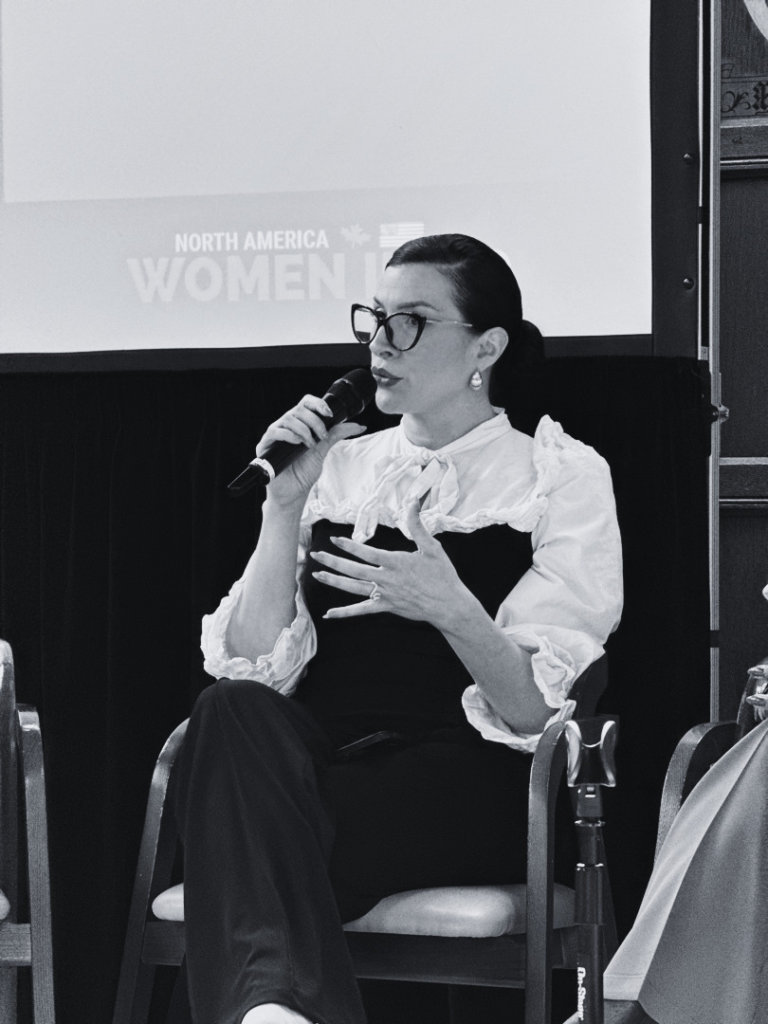
This was the conversation Stephanie Armstrong joined at the WorkWell Conference in Toronto, hosted by Women in PR North America, her first international engagement. She sat on the panel “How Are Communicators Thinking About AI in 2026?” alongside communications leaders from across the continent, brought in to help the room think through exactly this shift: what happens to authority when anyone can generate a plausible version of expertise in seconds.
Her position on the panel was direct. AI produces a competent draft of almost anything, and the competent draft lost its value the day everyone could generate one. What holds value is the specific experience, the specific client win, the specific way one person sees a problem that a thousand equally qualified people are looking at too. That specificity is the product now, and it comes from exactly one source.
Communicators in that room live this pressure daily. Client work moves faster because AI handles the first draft. The differentiator sits underneath the draft: the point of view, and that still has to come from somewhere human. The client pays for judgment. The model supplies the typing.
The panel spent real time on where the line actually sits, because every communicator in that room uses these tools constantly, the same way every industry now does. The question that decides everything comes after the tool finishes: whether the piece still carries a specific, identifiable point of view. A draft assisted by AI and then shaped hard by a real perspective reads one way. A draft AI produced and nobody touched again reads like everyone else’s.
Trust sits underneath the whole question. The panel dug into where AI genuinely enhances creative work, where it creates risk, and how communicators deploy it while keeping brand trust intact. A reader who senses a brand outsourced its convictions extends that brand less of everything: less attention, less belief, less budget. The brands holding trust through this shift are the ones whose audiences can still hear a person in the copy.
The discipline that wins the next stretch
The professionals and brands who win from here will use AI to move faster while keeping every piece of output unmistakably theirs. That takes discipline most teams are still building. It means reading a finished draft and asking a harder question than “is this good.” It means asking whether a competitor’s model could’ve produced the exact same paragraph, and when the honest answer is yes, going back in and adding the line only this brand, this founder, this specific voice would’ve said.
Origin is the asset. Protect it.
Stephanie Armstrong appeared as a panelist on “How Are Communicators Thinking About AI in 2026?” at the WorkWell Conference, hosted by Women in PR North America, at Hart House in Toronto on May 8, 2026.