There are two kinds of authority in any room, and only one of them belongs to the person holding it.
The first arrives attached to a seat. It comes from a title, a reporting line, a decision someone else made about where a person sits. It works while the seat holds. A reorganization, a new manager, a market correction, and the same leader walks into the same meeting carrying less of it. Positional authority is loaned, and the lender keeps the right to call it back.
The second one gets built. It comes from what a leader knows, what she has delivered, and what people say about her in rooms she has already left. It travels across every scroll, every role, every table. It opens doors before she knocks. Personal authority stays with the person who earned it.
Titles create introductions. Personal authority creates influence.
The odds get rationed twice
The distance between those two authorities is where the numbers live, and the numbers are blunt.
Start at the first rung, the step from individual contributor to manager. For every 100 men promoted into that first management role, 93 women make the same move, and 74 women of color do (McKinsey and LeanIn, Women in the Workplace 2025). The rung where a career begins is the rung where the math starts running against her, and every level above it draws from a pool that was thinned on the way in.
Follow that math to the top of the building. Women hold 29% of C-suite seats. Women of color hold roughly 7% (McKinsey and LeanIn, tenth-anniversary report, 2024).
Two numbers, one verdict. The odds get rationed at the very first rung, and the recognition gets rationed after.
Every source of authority is already in her hands
Read those figures as a story about qualification and they mislead badly. The credentials are here. The drive is here. The results are here. The recognition is the only thing running behind.
Authority is made of education, credentials, track record, lived experience, and perspective. Every one of those already sits in the hands of the women that data describes. The rarest of them is the last one: years of pattern recognition no one else has lived, held quietly by the person who lived them.
So the gap is a gap in information, and everyone has it except the woman it describes. She knows what she has done. The room decides based on what it can find. Visibility closes the distance between who a leader is and how she is known, and personal brand is the discipline that closes it on purpose.
Author your authority
Stephanie Armstrong teaches that discipline as four pillars, sequenced in the order people actually want the information when they decide who someone is.
Position comes first, because a headline is the first thing read and the fastest thing judged. A job title describes a seat. A position names who a leader serves and the outcome she creates. A stranger should be able to tell which one he is reading inside five seconds.
Point of view comes second. Expertise is what a leader knows. Point of view is what she thinks about what she knows, and it belongs in an About section that opens with a belief and saves the résumé for later. One perspective, held in public often enough that the room can repeat it back.
Presence is third, and it runs on two tracks. Online it works as rhythm: one territory, three posts a week, showing up where peers and decision-makers already spend their time. In person it works as alignment, where the room meets the same person the profile promised. Same voice. Same conviction. When the two match, trust arrives on sight.
Proof closes the sequence. Proof is the authority other people can see: a recommendation, a result, a recognition, all of it findable in about ten seconds. Authority that stays private stays invisible. Receipts let credibility travel into rooms the leader will never enter.
What the room built
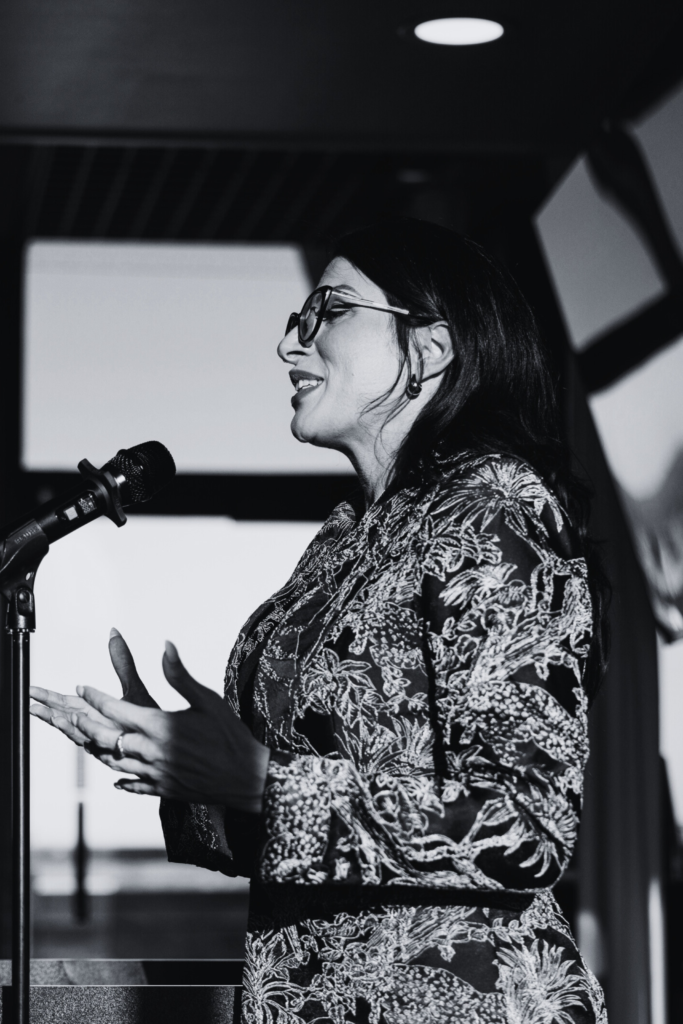
Stephanie brought that framework to the seventh annual Women of Color Summit in Niagara Falls as a workshop trainer, running the final workshop block of day one before the closing charge, in front of a summit that convenes more than 300 women and allies from across New York State.
A training session asks more of a room than a keynote does. A keynote delivers an idea and trusts the audience to apply it later. A workshop puts the work in the room, live, with the outcome measured by what people carry out the door. This room did guided work on all four pillars: rewriting headlines against the position formula, opening an About section on a stated belief, choosing a single territory and a weekly cadence, and naming three pieces of proof to make findable. The session ended on four moves with a deadline attached to the first one, which was that week.
Handing a 300-person room of leaders and allies to a trainer for that final block is a statement about what an organization believes she can deliver. Stephanie founded Moxie Creative Studios and has spent 15-plus years on brand strategy across global markets for Fortune 100 clients, with $45M+ in revenue growth driven by executive positioning and the Authority Equity™ methodology behind it.
The summit built its year around B.R.I.D.G.E., a theme of building respect, inclusivity, determination, growth, and equity. A bridge is a structure. Structures get built, span by span, by the people who decide to build them. Personal authority works the same way, and the four pillars are the spans.
Every woman in that room walked in already qualified. The work is becoming recognizable.
Positional authority can be taken.
The authority you build is yours. Build that one.
Stephanie Armstrong led the workshop “The Alchemy of Presence: Engineering Influence through Embodied Leadership and Strategic Visibility” at the 7th Annual Women of Color Summit, hosted by Partners in Community Development, at the DoubleTree by Hilton in Niagara Falls, NY, on June 3, 2026.