Credentials alone won’t save you in a saturated market. While peers disappear into the Sameness Trap, the professionals who own a defensible position are the ones who get called first. Discover the ICONS framework, a specific, five-move strategy to translate your expertise into a stance that survives the retelling.
A room full of qualified experts sounds like one expert on repeat.
Same credentials. Same fluency. Same calm under pressure. Ask ten of them what makes them different and most give the same three answers: hard work, deep expertise, a client-first approach. The words repeat until they stop meaning anything.
Stephanie Armstrong, our founder, calls it the Sameness Trap, and it lives everywhere qualification is table stakes. Consulting. Finance. Law. Executive coaching. Every field that demands real credentials now carries a surplus of people who hold them. Qualification used to be the differentiator. Now it’s the entry fee.
Clients feel the shift before they can name it. They meet three equally qualified candidates for the same engagement and choose one anyway. Something beyond the resume tipped that choice.
The shift runs deeper than preference. Buyers decided before the call. They researched, compared, and formed a verdict in rooms the professional never entered, and the person whose position was clear before the conversation started walked in already chosen. Qualification opened the door. Position decided who walked through it.
That something is position: the clear, specific, defensible stance a professional takes on what they do and why it matters, stated plainly enough that a stranger repeats it back correctly after hearing it once.
Own a position, and you get chosen. Describe what you do, and you get compared, ranked, and forgotten by the second meeting.
The comparison happens in the retelling
A prospective client reads three bios and remembers the one that said something specific. “I help executives negotiate exits” beats “I provide strategic counsel across a range of corporate transactions” every single time, because a stranger can repeat the first one correctly to a colleague an hour later.
Positioning survives the retelling.
The research puts numbers on the advantage. Thought leaders command up to a 60% pricing premium over peers who publish no point of view, according to the 2024 Edelman-LinkedIn Thought Leadership Impact Report. Clearly PR found that 53% of buyers say thought leadership directly influenced a final purchasing decision. And Hinge’s research on elite professionals, published in The Visible Expert, found that “Fast Trackers” reach industry-authority status roughly five times faster than their peers and are four and a half times more likely to receive speaking inquiries.
Visibility changes outcomes on its own. Independent of expertise.
Being good gets you ready. Being known gets you chosen.
Expertise still carries the weight underneath all of this. In a saturated field, though, out-credentialing your peers stopped being an option years ago. The professionals separating themselves now translate real expertise into a position specific enough to survive a hallway conversation between two strangers comparing notes on who to call.
Five moves, done in order
Stephanie built the ICONS approach for exactly that translation: identify your position, call out the tension the market is avoiding, own the outcome the work produces, name the proof that backs the claim, and send it forward, publicly, so the position exists somewhere beyond a single conversation. The approach distills 15 years of executive identity work across global markets and over $40 million in client revenue growth driven by leader clarity and positioning.
Each move sounds simple in isolation. Together, in order, they force a choice. A defined position always excludes something. It tells one kind of client this is exactly who I serve, and that commitment is what makes a stance work. Being known for one thing builds trust. Exclusion creates authority. The right audience recognizes a committed position immediately as the only call worth making, and the market remembers the professional who claimed one specific thing, loudly enough to be found by the people who needed exactly that.
That specificity filters as much as it attracts. A clear stance tells the market where a professional stands, and it tells referral partners exactly when to say her name. Vague experts collect polite nods. Specific experts collect introductions.
A room where positioning was the only variable
The idea met its cleanest possible test this spring in Rochester.
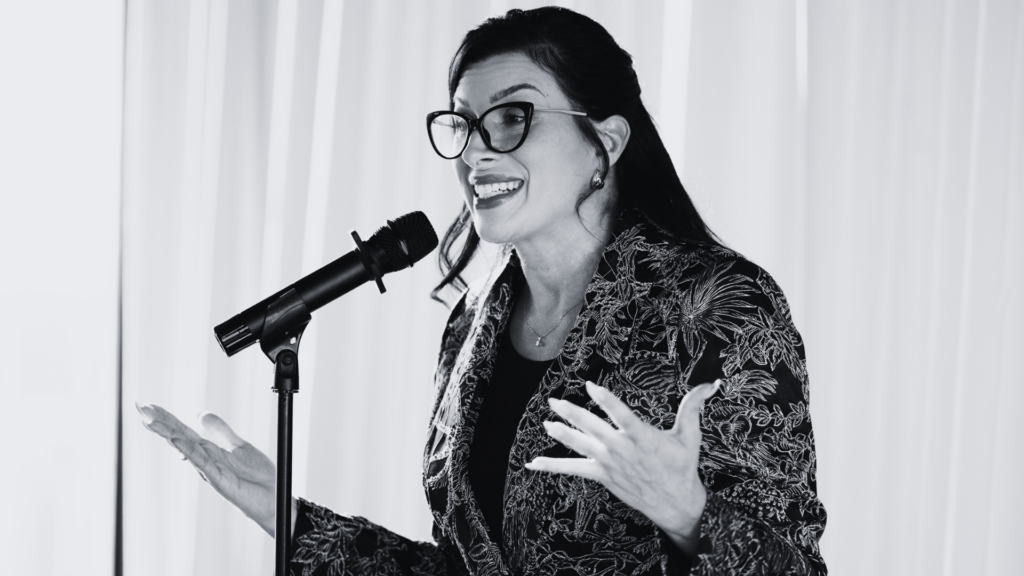
Stephanie delivered The Iconic Stance as the keynote for Woods Oviatt at The Arbor Loft, and the room was full of attorneys. Law proves the thesis better than almost any field. Every person in that room passed the same bar exam and built a career on the same baseline of rigor. Nobody could out-credential the person next to them. Positioning was the only variable left standing, and it was the entire subject of the session.
The room walked the ICONS sequence live, workbooks open, against a tension every attorney recognized from their own referral pipeline: clients arrive assuming competence. What they’re actually evaluating is which specific attorney to trust with a decision that matters. By the end, every attorney in the room had drafted an Iconic Stance Statement, one specific enough to work in a bio, in a boardroom, and in the referral conversation that ends with the most valuable question in business: who do you know?
The attorneys who left with a defined stance walked out holding a reason to be the first call. Their colleagues carried the same credentials into the same market and kept competing on effort. The market rewards specificity long before it rewards effort, and a room full of hardworking, credentialed professionals is exactly where that lesson lands hardest.
The verdict
Positioning is a decision. A professional decides what they stand for, states it clearly, and repeats it until the market can recite it back. That repetition is where most professionals quit. They state a position once, in one bio, on one page, and assume the work is finished. The market needs to hear the same clear stance enough times to trust it.
All the decision asks for is clarity, stated on purpose, in public, more than once.
Positioning is a decision, and the professionals who make it get chosen first.
Stand somewhere. Let the right people find you there.
Stephanie Armstrong delivered the keynote The Iconic Stance, hosted by Woods Oviatt Bilgen, at The Arbor Loft in Rochester, NY, on April 16, 2026.
Want The Iconic Stance in front of your team? Stephanie keynotes for firms and organizations nationwide. Inquire about speaking →